The most sought after leather handbag in the world is the Birkin bag by Hermès.
In a fantastic essay entitled “How Hermès Sells ‘Time‘”, Trung Phan offers a primer on the Birkin bag:
For the uninitiated, Birkin and Kelly bags start at ~$10k (but regularly sell for $50k to $100k on secondary markets). Each one is handcrafted and takes 20 to 25 hours to make. The supply is tightly controlled and the process to attain one is arduous.
Interestingly, there is an education equivalent to the Birkin bag.
It is Harvard University.
Harvard is probably the most prestigious educational institution in the world. And to maintain that prestige, it has not increased its undergraduate student population in nearly 40 years, despite its endowment swelling over that same period.
This stagnant growth in their undergrad population is a tacit admission that Harvard is primarily invested in maintaining its image as a luxury brand rather than fulfilling its mission.
Here’s the Harvard endowment over time.
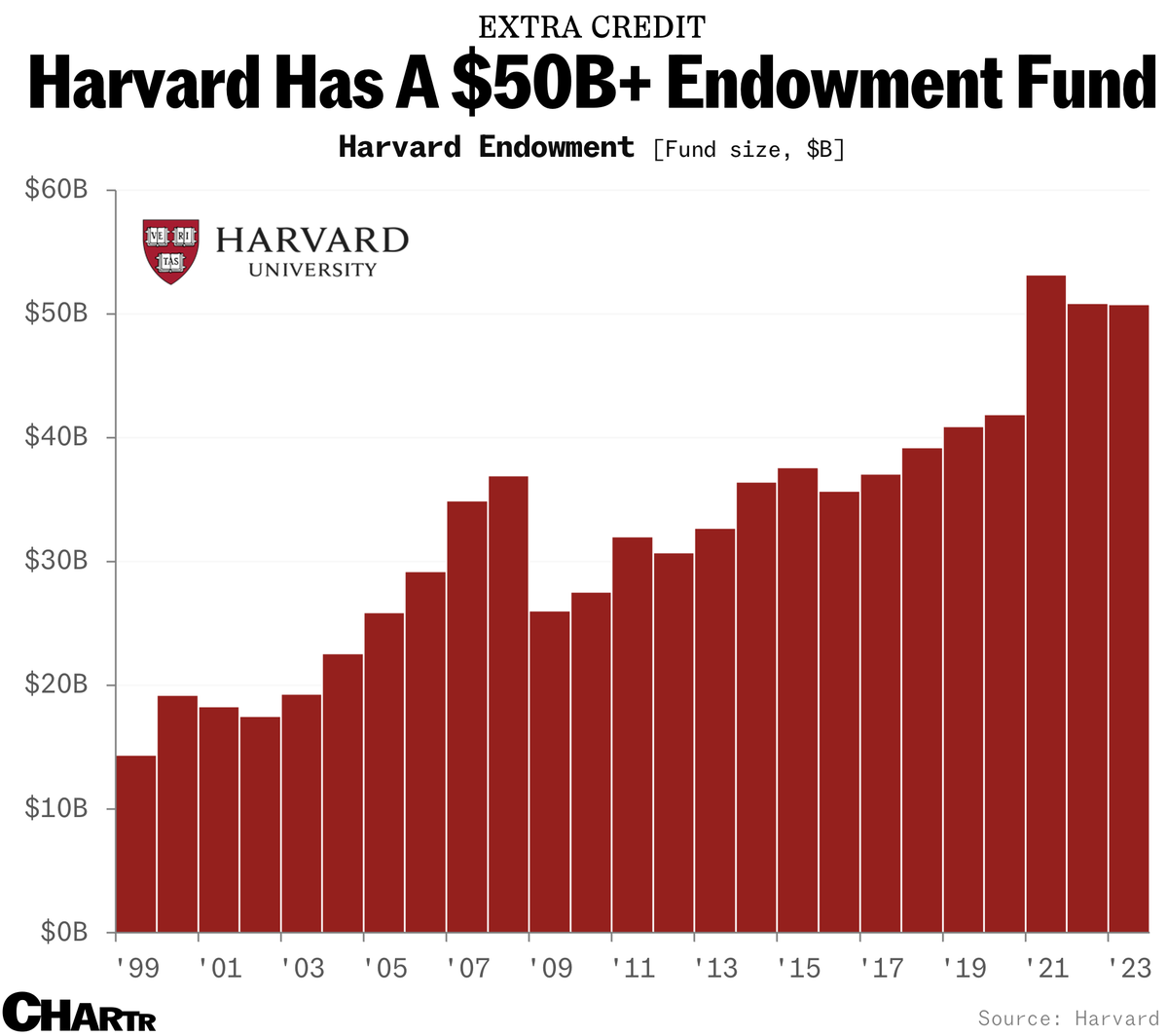
Quick summary:
- 2023 – $50B+
- 2012 – $30B
Here’s the number of Harvard undergrad acceptances in the same time periods:
- 2023 – 1942 students
- 2012 – 2076
So from 2012 to 2023, the endowment grew 67%+.
At the same time, acceptances declined 6.4%.
Is the rest of the Ivy League limiting supply as much as Harvard?
Interestingly, Harvard isn’t like the other Ivy Leagues as reported by The Crimson:
Yet Harvard might be the only one in this elite club to have seen such stagnant growth in its enrollment for so long. About 2,200 high schoolers were admitted to Harvard’s Class of 1982. That number was 2,147 in 1992, 2,074 in the mid-2000s, and just 1,980 for this year’s freshman class. Because the yield rate — the percentage of admits who choose to enroll — has risen steadily since the 1980s, the freshman class has stood virtually unchanged at approximately 1,600 students for more than four decades.
Yet Cornell, Dartmouth, and Brown have all seen their student bodies grown by at least 15 percent since the 1980s. Yale’s enrollment was steady for decades until it expanded its freshman classes by nearly 20 percent beginning with the Class of 2021. Harvard’s enrollment? No significant change to speak of.
Of course, the Ivy League overall hasn’t grown as much as it probably should. Scott Galloway has highlighted that over the past 30 years, the number of seats at Ivy League schools has increased only 14% while the number of high school graduates has expanded by 44%. Note: Galloway’s essay entitled Rot is worth a read.
Peter Thiel says that increasing enrollment would be career suicide for Harvard and Stanford’s presidents. It would anger professors, alumni, students and parents. After all, luxury goods are not for the masses.
But, but…we just don’t have the space
Harvard folks contend they don’t have space.
This is a nonsensical and laughable argument. The ‘smartest’ people in the world can’t figure this out? Really?
- They’ve built a 544,000 sq ft engineering building recently and already have expanded campus outside of Cambridge.
- $50B says this is a solvable problem
The student body isn’t growing, but the bureacracy is
There is a famous maxim dubbed Parkinson’s Law that states that work expands to fill the time available for its completion.
Coined by C. Northcote Parkinson in the 1950s, the focus of Parkinson’s study was actually on the British Civil Service. As the BBC highlighted, Parkinson found the following about this bureaucracy (emphasis mine):
In his original essay he pointed out that although the number of navy ships decreased by two thirds, and personnel by a third, between 1914 and 1928, the number of bureaucrats had still ballooned by almost 6% a year. There were fewer people and less work to manage – but management was still expanding, and Parkinson argued that this was due to factors that were independent of naval operational needs.
Interestingly, Harvard’s bureaucracy is growing similarly.
While undergrad classes have held flat since 1982, the administrative class continues to grow.
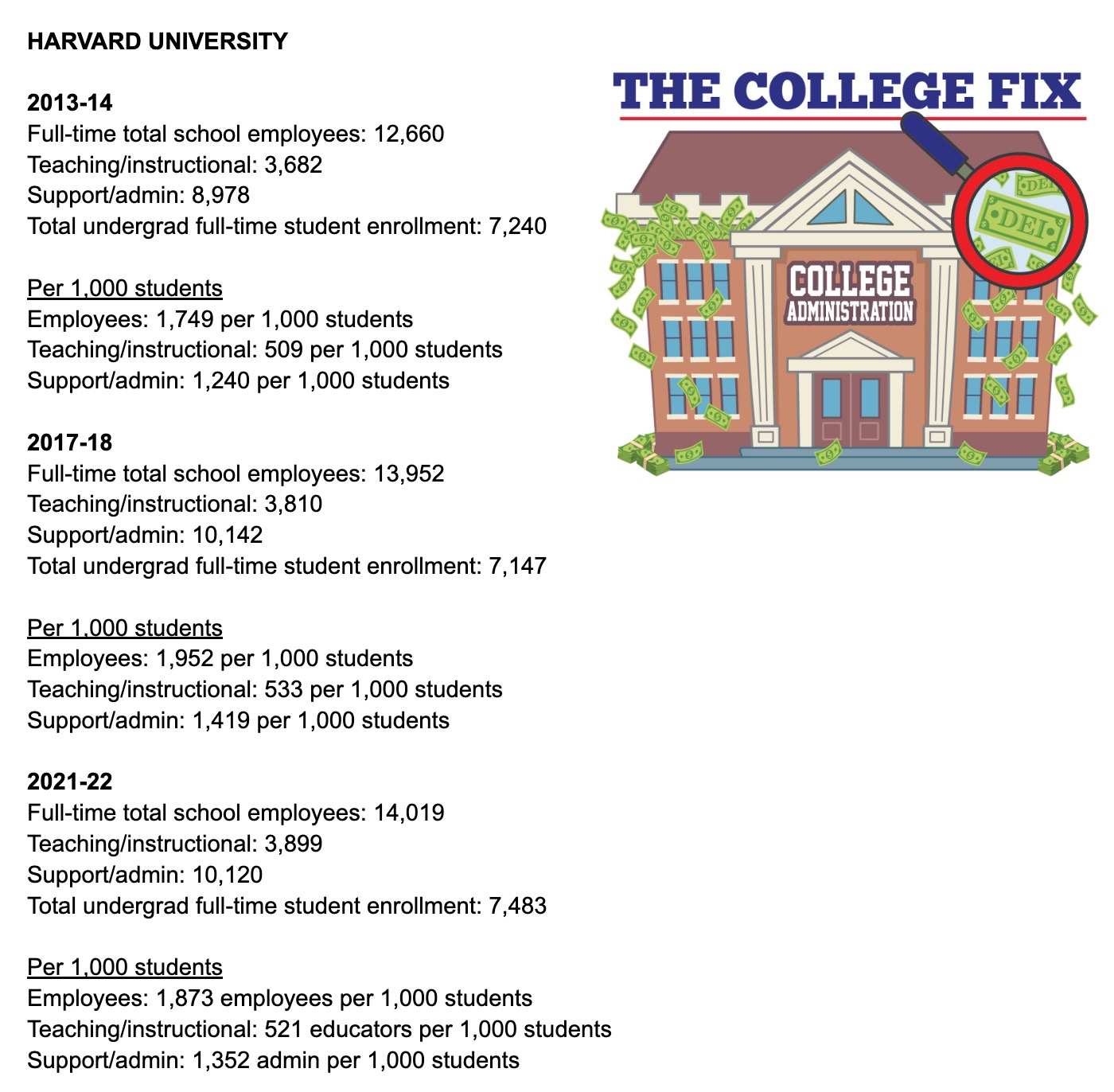
Per The College Fix, here’s the stats on growth of administrators at Harvard.
Harvard University employs about 1,352 full-time administrators for every 1,000 undergraduate students enrolled at the university, an analysis conducted by The College Fix found.
This is more than a nine percent increase from the 2013-14 school year, when there were 1,240 administrators per 1,000 students
Scientists Stefan Thurner, Peter Klimek and Rudolf Hanel attempted to turn Parkinson’s law into a mathematical formula and believe that:
Parkinson argued that if you have 6% growth rate of any administrative body, then sooner or later any company will die. They will have all their workforce in bureaucracy and none in production.
So perhaps fewer students (“production”) and the growth of the administrative class is an indicator of Harvard’s eventual demise?
Note Below is the data on administrator growth from 2013-14 through 2021-22.
Leave a Reply