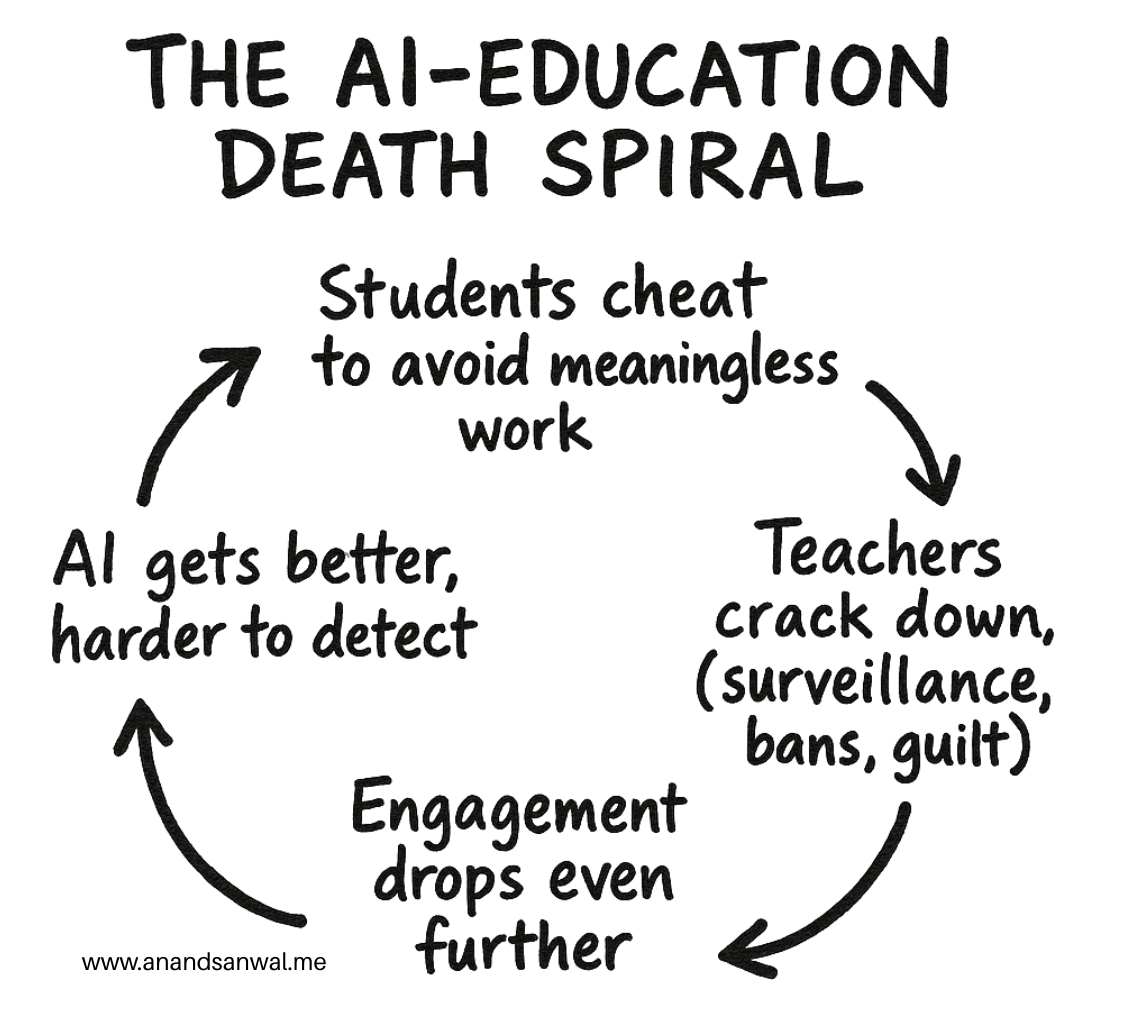
The AI-Education Death Spiral aka Let the Kids Cheat

·

AI education death spiral

This essay first appeared in my newsletter. Sign up here if interested in Unf^cking Education.


Your kid didn’t write their essay last night. 

ChatGPT did.

And that might be the most honest thing happening in school today.

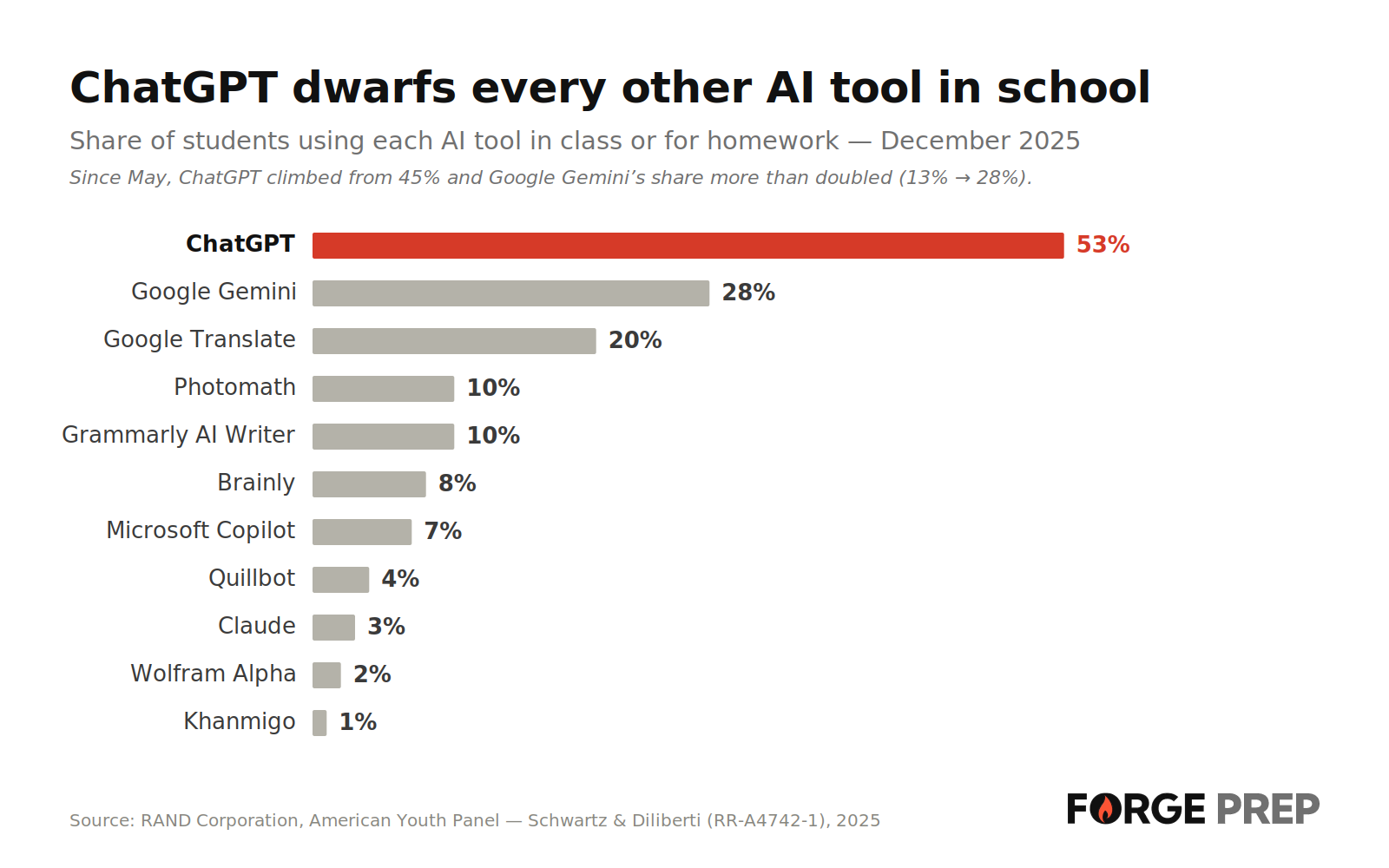
They’re copying essays from AI, running them through “humanizing” tools, and handing in work they’ve barely read. They’re having AI listen to lectures so they don’t have to. They’re sneaking AI via their mobile phones into tests.

They’re using ChatGPT for everything from math homework to history essays to college applications.

And they should be.

To be clear, I’m not advocating for AI in real learning. AI is only useful right now as a stress test as it reveals how hollow adolescent work has become. If it pushes schools toward offering work with relevance, impact, and agency and away from hopeless busywork (“When will I ever use this?”), that is a win.


Because AI isn’t the problem. 

It’s just a light revealing how fake and pointless school has become.

The Death Spiral Has Already Begun

Walk into any high school classroom. A majority of the work is written by AI.

Everyone knows. Most say nothing.

Teachers pretend to grade. 

Students pretend to write. 

It’s as much about learning as taking your shoes off at the airport is about security.

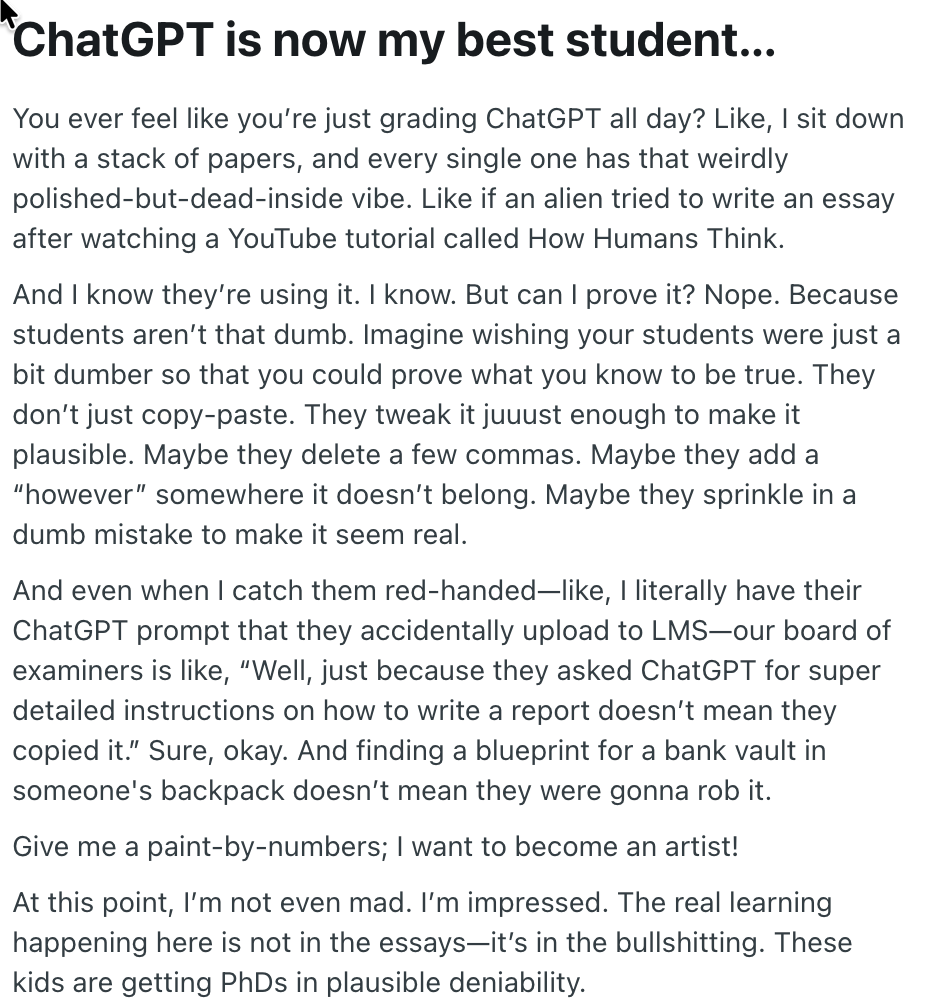
Teachers and professors acknowledge it is rampant, but there is little they can do as evidenced by this post.

The author of this post ended it with this humorous conclusion.

So yeah. ChatGPT is my best student now. It hands in perfect work, never complains, and never asks for an extension. And the worst part? I think I like it better.

And as highlighted above, this is “every single paper”, i.e., this isn’t a few bad apples. 

Parents who found their daughter cheating on multiple assignments heard:

“Everyone is doing this” and that it’s the only way to stay competitive.
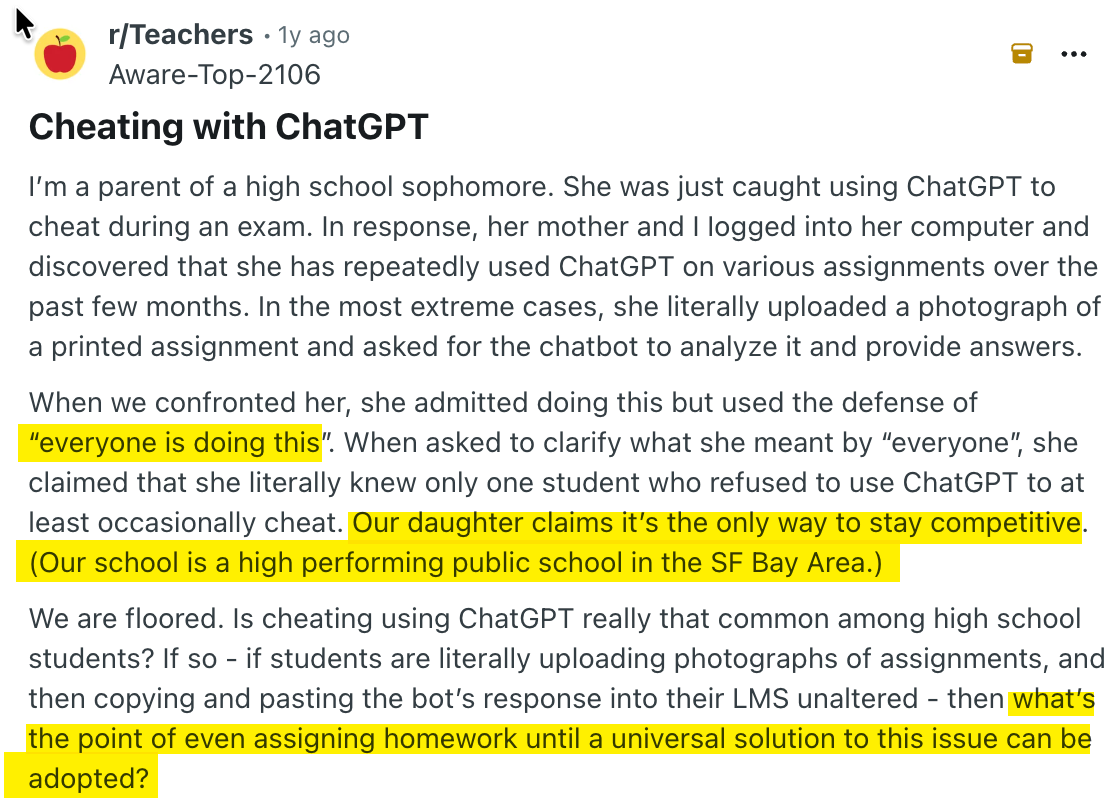
McCabe’s research confirms this: once cheating becomes normalized and the system loses legitimacy, defection becomes the dominant strategy.

This is the classic prisoner’s dilemma.

  • If everyone plays fair, all benefit. 
  • But if others cheat and you don’t, you fall behind. 
  • So even the “good” students feel forced to cheat just to stay even.

This, however, isn’t a moral collapse. 

It’s a design failure.

The real revelation? 

AI exposed that a lot of school work isn’t worth the effort. 

Maria Montessori said it a century ago: 

“The work must be something the child feels is worth doing.”

Schools forgot and flipped that. 

They assign work and expect kids to value it merely because it was assigned.
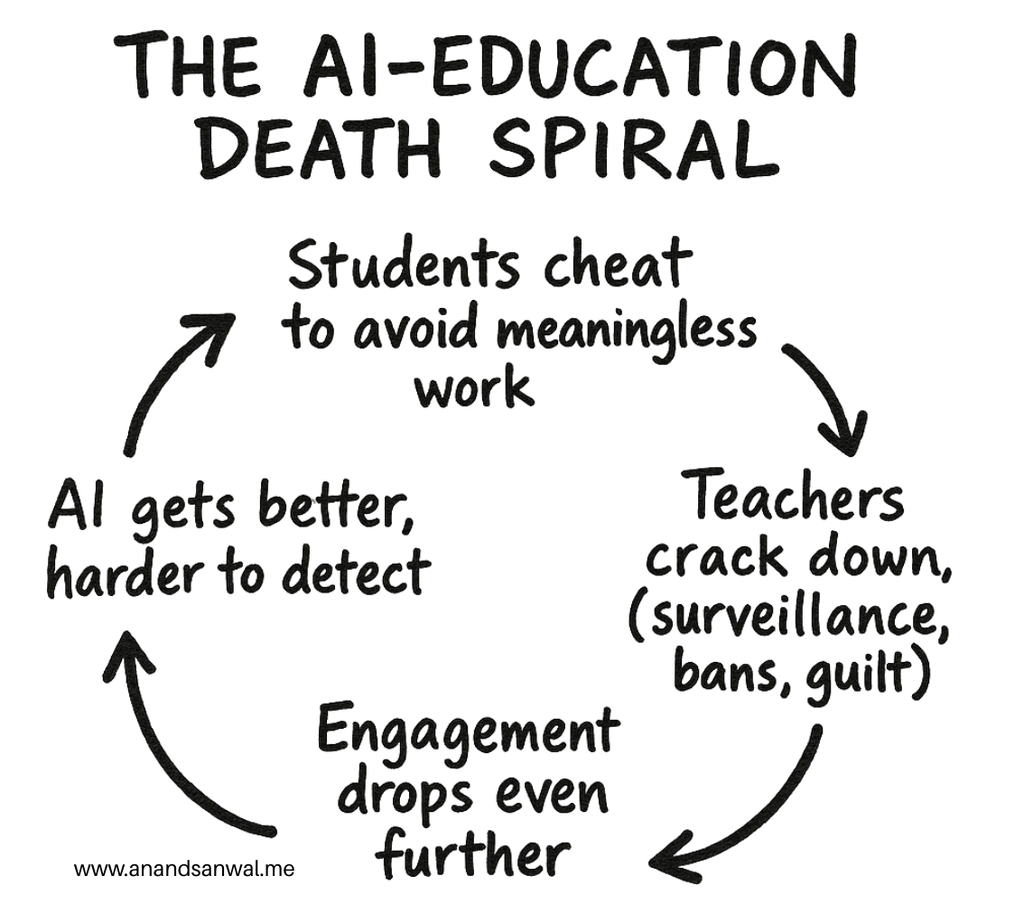
The Predictable Crackdown

Some schools and teachers unhappy with the theater chose not to look the other way and responded exactly as you’d expect.

First came the guilt: “You’re only cheating yourself.”

When that inevitably didn’t work, they escalated to AI detectors that don’t work, forced handwritten essays, laptop bans, surveillance tools.

They made classrooms, places where you’re already told to sit still and do as you’re told, even more prison-like. Not surprisingly, this same strategy is being used at universities as Princeton University professor D. Graham Burnett reveals in this response on the Hard Fork podcast who states:

We’re like the sheriffs. and so the concern is all my assignments are now useless. I can’t assign papers. Am I going to have do a blue book exam?

Their strategies, as you can see, are almost all punitive. 

As one lecturer inspiringly put it:

“Catch what you can, no mercy for the damned.”

And then they wonder why students check out even more.

Here’s what they never admit: AI didn’t create the problem. It just revealed it.

The Coming Collapse

Follow the money.

What happens when a 4.0 GPA means nothing because half the work was done by AI?

We’ve seen this before. 

During COVID, when school went virtual, parents saw what was really going on. 

The result? 

Public school enrollment dropped by 1.3 million. States like Oregon and New York lost over 5% of their students.

And it will similarly accelerate when parents realize they’re paying (via taxes or tuition) for education theater and their students are actually learning very little.

Colleges will then quietly start ignoring GPAs

Employers will stop trusting transcripts. 

And when everyone acknowledges that the product is worthless, the economic foundation collapses.

What Survives the Stress Test?

AI is a filter. 

It strips away everything that can be automated, leaving only what requires actual thinking: creativity, collaboration, real-world problem-solving.

Deci & Ryan’s research says people engage when they have autonomy, competence, and purpose. 

School as we’ve constructed it for hundreds of years kills all three.

But some are adapting. 

  • At High Tech High, students tackle real community problems. 
  • At Forney ISD in Texas, students run actual businesses inside their school. 
  • At the School of Entrepreneuring, students identify and solve real problems on behalf of others while working together.

Boalar’s research confirms this: when work is relevant and challenging, cheating drops dramatically. 

Not because it’s harder, but because students actually want to do the work.

We need to move to education that prioritizes engagement (note: school need not be easy or fun. It requires productive struggle)

Let It Burn

AI cheating highlights that much of what passes for education today has no value. 

So let AI burn down and reveal how inane this work is.  

Let it break the model so we can finally build something better.

Because the students have already figured it out.

The next time a teacher complains about AI cheating, ask: If a machine can do this assignment perfectly, why are you giving it to this student?And then we can replace it with education and work that actually matters.

27 responses to “The AI-Education Death Spiral aka Let the Kids Cheat”

  1. […] It is these same weapons they’re employing in the battle with AI which they will lose all while they break education completely.  […]

  2. we need to workout the ripple effect of AI across every vertical – education, housing, healthcare, etc. —– can I use an AI for that? 😉

    1. Yes, indeed. But AI can’t build houses (yet) and will likely enhance healthcare. In education, it completely makes and highlights the current product is obviously irrelevant.

  3. Have you broken this to the teacher unions yet?

  4. “AI didn’t create the problem. It just revealed it.”

    This is blatantly false. Sure there were always some jocks and/or rich kids that had their work done by others, and yes that was a problem, but the rest of the kids? They had their education re-enforced.

    It’s not about the actual writing of the essay, it’s about the thinking about the subject in a critical way, and because of that, having the information stick. If AI now writes the essays, what is sticking? nothing. If AI now does the math homework, where is the practice? there isn’t any.

    Literally AI use in schools is the problem. The children are no longer learning. The used to, and now they are not. How can you say AI isn’t the issue?

    1. Thanks for your comment.

      Let me offer some facts.

      There has been a consistent slide in US education outcomes (that pre-dates AI). You can see it in our test scores vs other nations (PISA for example) as 1 metric beyond the visceral sense that our students are falling behind. So the idea that students used to learn and they no longer are is just false.

      Let’s also consider that schools:

      1. have become less rigorous (thanks grade inflation and state funding gamesmanship)
      2. teach for standardized tests and not actual learning
      3. offer work which has not changed much in 100 years (warehousing of facts & trivia, lectures, etc)
      4. increasingly attract talent that is not top-tier (they’re paid poorly and the job is not selective)

      We can (and will) blame students for their responses to the pointlessness of it all or we can try to develop a model that offers them relevance, impact and agency and which focuses on application of knowledge vs the mere transmission and regurgitation of information.

      AI is exposing this and most schools are adopting punitive measures (jailer vs inmate mindset) instead of rethinking what education should be. Those schools deserve to fail as they’re failing our young people.

      Thx again for reading.

      1. > “There has been a consistent slide in US education outcomes (that pre-dates AI). You can see it in our test scores vs other nations (PISA for example) as 1 metric beyond the visceral sense that our students are falling behind. So the idea that students used to learn and they no longer are is just false.”

        This is literally the opposite. Your fact proves that kids used to learn and no longer do. How can there be a decline in metrics if they didn’t learn in the past?

        Your numbered information is not disputed by me at all. I agree with that.
        It’s your conclusions that seem backwards. If the teaching hasn’t change for 100 years, but kids got worse at learning… then aren’t the children the problem? Degraded by parents or technology? Something is causing worsening test scores – and if the teaching hasn’t changed, then the teaching is not the problem. Look for things that have changed. If your car has been fine, and you drive it the same way, and it it stops moving despite you doing what you have always done. Are you to blame or is the car? You didn’t change, so it must be the car.

        AI is exposing a problem, I agree. I just don’t see how to blame the school process, when it has not changed.

      2. That’s a sharp point.

        If schools have not changed but scores are down, it is fair to ask if students are the problem. But the world students grow up in is unrecognizable compared to when this system was built.

        The school model was designed for the industrial economy, to produce compliant, punctual, standardized workers for predictable, long-term jobs. Today’s economy rewards creativity, adaptability, and initiative.

        Yet schools still run on that 100-year-old operating system.

        At the same time, students live in a world of constant digital distraction, weaker community ties, parental over involvement or total absence, and schools that often lower standards rather than raise them. Teacher quality has declined, attention spans have shortened, and culture now prizes stimulation over substance.

        So it is not that kids have gotten worse. It is that everything around them changed while schools stayed still. In a world this dynamic, standing still is the same as falling behind.

    2. Schools operate mostly on least common denominator. Most classes and education is conducted at the lowest/slowest level thus resulting in smarter kids bored out of their skull. Unchallenged. They are also “teaching to the test” instead of teaching skills. Why? Because funding is setup this way.

      Do we really need 12 grades (primary, middle and high) to teach what most people need for day to day? I would argue by 5th or 6th grade students should have all the knowledge most will need for their life and to be a functioning and contributing member of society. Instead the first few months of every grade is a repeat of the previous grade further reinforcing the “check out” mentality of the students with little new material added on each year.

      How about instead teaching skills? 7th and 8 grade should each be a series of week long topics. Week 1 sewing. Week 2 computer programming, week 3 house carpentry. Week 4 cooking, week 5 accounting, week 6 stock trader, week 7 landscaping, etc. By the end of two years of this you can, arguably, cover about 80 different skill sets. High school can be refinement of what the student liked. Enjoyed building a house? Then high school can be classes focused on learning construction, perhaps with electrical work. Now you get into geometry, ohms law, etc. Something that a student interested in, say, cooking would not need, but that cooking student would need to understand measuring, ratios, basic chemical reactions, presentation and more. By the end of high school you now have a couple of marketable skills (2 years in one area and 2 years in another).

      At this point you are ready for the work force unless of course you are building a bridge or operating on me. Those are the areas where further college education is justified. Otherwise the rest of our work force are getting degrees just to pass the HR (and how AI HR) hurdles, not because the job actually requires it. I never hirer candidates based on education, rather on work experience.

      How does this all tie into AI? The current system fosters the use of AI to game it and get by. Maybe because you are bored or don’t see the point or don’t like the teaching style (some learn by book, some by watching, some by doing) or whatever reason. Use AI to pass and move on. With a different approach you have students engaged and wanting to learn, develop skills/knowledge and have taken AI mostly out of the equation.

      So yeah, I agree with the author… burn the current system down and start over. AI has revealed many of the flaws in it and I don’t see those flaws as fixable with the current model.

      1. Gary – great articulation of many of the challenges of the legacy system. AI is just highlighting its relevance.

        BTW, I like many of the ideas on not wasting all this time on college but a lot of adults will push back on that under the banner of “let kids be kids” but the underlying worry is an economic one, i.e. smart, hardworking and technology proficient young people will compete for jobs.

        BTW, we’re building a school that adopts many of the practices you’ve detailed above.

        http://www.forgeprep.org

  5. « It’s the only way to stay competitive » says a student. Yes if you get away with it until you graduate (and maybe you keep doing it through college) and then all of the sudden you aren’t competitive in the world because you’ve taken short cuts and never built the foundation you need to be an innovative and creative person. The divide between privileged kids who will have the kinds of enriching activities and experienced and indeed education that can’t be outsourced to ChatGPT will become more pronounced. Those students who imagine that they can do all their work using AI – not as a learning tool but as a substitute for critical thinking and reasoning and writing – will be unemployable and easily replaced. When I have successful leaders come to class at Brooklyn College they always say that they built those skills in college by taking on leadership roles in clubs and student government and by putting all their effort into their courses and assignments. They apply that same initiative in their careers. The groundwork for that drive and dedication started in high school and depended to a degree on earlier education. Your point about innovative education grounded in experience is excellent. We still hear from students who were taught by Ted Liebowitz a Brooklyn College alumnus in an entrepreneurship class years ago where they learned how to buy and sell merchandise on campus. They may be working in investment banking or running a successful business and they say how formative this experience was in shaping them. He’s now working with us on starting a student run store where our students interested in being entrepreneurs will eventually sell their creations. Students who attend CUNY’s Latin and Greek Institute are immersed during an intensive summer program in 5-6 semesters of Latin or Greek. Each university has a wealth of opportunities that students can choose that will build leadership skills and knowledge. The students taking advantage of these opportunities which are so plentiful are the ones who will be fulfilled in life and who can adapt to changing circumstances in our world.

  6. This is an articulate articulation of the problem. But serving teachers a low blow is easy (and they are used to being blamed for society’s abdication of responsibility). What are your thoughts on the solution(s)? If the old system was to produce factory fodder for the industrial age, was that ever right? And what are we to produce now… scrolling thumb people? Consumers with no wage? Everyone an entrepreneur? Who will consume the ‘product’ from ever more startups?

    1. Thanks for the comment Bob.

      I didn’t mean to come down hard on all teachers – just the ones who are doing these pointless punitive things to “keep AI out”.

      In terms of what schools should do, there are many known practices rooted in educational philosophy, developmental science or education research which are battle-tested and work which schools are reluctant or unwilling to adopt. But the biggest thing is to offer an education that offers students relevance, impact and agency.

      We are building schools to do this (www.forgeprep.org) and are teaching what we call entrepreneuring. This is not about building startups.

      From this essay, I wrote:

      It’s a disciplined way of solving problems on behalf of others—by observing needs, generating ideas, testing solutions, and adapting quickly based on feedback.

      It’s closer to engineering than to “entrepreneurship.”

      Where engineering applies structured thinking to physical systems, entrepreneuring applies structured thinking to human problems—sometimes mundane, often messy, always uncertain.

      Entrepreneuring is a practice.

      It is something you do. And through failure, and iteration, you get better at it.

  7. As a high school science teacher, I have to blatantly disagree with the main point of this article. “If a machine can answer these questions, why are we giving these questions to our kids” is missing the entire point of education: to train YOUR BRAIN to be able to solve problems, to get YOUR BRAIN to think critically, to make YOU more resilient to adversity. We don’t stop teaching kids addition and subtraction and how to read because a computer can also do these things, unless the goal is to create a world full of mush brained people who can’t function without the help of a artificial supercomputer at their fingertips. If the goal is to produce a world of real world problem solving community members, that starts with THEM having real knowledge… so yes, we should be going back to pen and paper, less tech in schools. And no, it shouldn’t feel like a punishment. It should feel like we’re doing what’s best for them, we’re giving them a space where they work their brain! That is a beautiful thing.

    1. Thanks DC.

      I agree with much of this, especially the idea that education should strengthen thinking, not outsource it. But that assumes schools are actually doing that today, which they largely aren’t.

      If our system was consistently producing resilient, critical thinkers, AI wouldn’t feel like such a threat. The truth is, for decades most classrooms have rewarded compliance and memorization, not reasoning or problem solving. That’s the gap AI is exposing.

  8. In the 60s and 70s schools largely taught subjects. In the 90s and 00s I saw my stepdaughter taught resume writing and pressing flowers in a book.
    Subjects are hard to justify to children. What will I use that for? So parents and then teachers surrendered.
    Subjects are what let children get a handle on adulthood – mutual responsibility. It needs to be taught rather than be expected to burst forth spontaneously just because children are bright.

    1. Thanks John.

      I think this is conflating a couple of things.

      I agree with you that school is less rigorous now for many reasons, i.e. school funding incentives, college admissions, parenting culture, grade inflation, etc. The result is “pressing flowers in a book”.

      But subjects are alive and kicking today and a big part of what makes what schools teach so meaningless. I wrote about why we should get rid of subjects here in favor of multidisciplinary projects (which evidence shows work better). But we don’t do this because schools and teaching is architected for subjects. Adult ease drives more education decisions than development, cognitive or social appropriateness for students.

      From the essay:

      This approach to education isn’t just inefficient; it fundamentally misunderstands how humans learn and apply knowledge.

      The division of knowledge into distinct “subjects” isn’t a cognitive necessity but a historical accident that has congealed into the most dangerous words in any system aka “that’s the way we’ve always done it”.

      The result is that we actively hurts students and their learning.

      As Harvard education professor David Perkins argues in his book “Making Learning Whole,” traditional education often teaches disconnected pieces without letting students experience the “whole game” of a field.

      source: https://anandsanwal.me/teaching-subjects-in-schools-is-dumb/

  9. I agree with the author that secondary and post-secondary education are in trouble, and post-secondary education in particular is trending towards certification/signalling over education. However, as employers are discovering, the signaling purpose fulfilled by a college degree is undermined if the kids don’t actually know how to do anything when they graduate college other than submit poorly formed questions to an LLM.

    Ok great — so what is the solution? I find it absolutely absurd that the author suggests that something like their new forgeprep school is the answer. If it is, it isn’t because of some fantastic tech-centered entrepreneurship BS. It is because, as the website for the school indicates, there is “1:1 coaching and mentorship from accomplished professionals.” If every school could provide 1:1 coaching and mentorship, there would be no education problem. I wish we lived in a country (or I lived in a country — the US) where education was valued enough that we would pay teachers sufficiently to attract greater talent and increase the overall number of teachers in schools. But we don’t. The solution to this is not yet more private elite schools that depend on VC funding. The solution is a political movement in which people become convinced that education is a public good, that all citizens both have an obligation to help fund that good, and a right to demand it be of high quality.

    1. Hi Colin,

      Thanks for the thoughtful comment. I agree with you on the big picture. Public education is a public good, and both K–12 and college are drifting toward signaling instead of real capability. Employers see it. Parents see it. Kids definitely see it.

      Some clarifications on assumptions you’ve made.

      Forge Prep is not VC-backed and it is not a tech-first school. I left my previous career, went back to school, and trained as an adolescent Montessori guide because I believe the future of education has to become more human, not less. The 1:1 mentorship is expensive but is right for adolescent development and so we do it. We pay teachers (aka Guides) 2-3x what NJ pays teachers becasue we think teachers serve as nation-building infrastructure and so should be paid well. We’re also attracting people to teaching who never before considered it because of the economic martyrdom it required.

      I also share your belief that this kind of education should be available to every kid. Our admissions are need-blind and our long-term plan is to open source the model so other schools can adopt it (including public). The challenge with our government schools that far too few people do anything about is that they are too calcified, complacent and corrupt to make the changes kids need at the speed they need them.

      So as parents ourselves, we stopped waiting. Instead of whining about the government, unions, college diploma mills or hoping these players suddenly transform themselves, we are building the school we think kids deserve righ now – not 10 or 20 years from now. If we get it right, public schools will adopt the parts that work if the can get their isht together.

      Some additional essays which you might find interesting are below.

      Thanks again for reading and the thoughtful comment.

      Anand

      My thoughts on how we have ruined the teaching profession and how it can become presitgious again
      https://anandsanwal.me/make-teaching-prestigious-again/

      On the incentives poisoning our schools
      https://anandsanwal.me/public-school-incentives-broken-corrupt/

      On the distractions they throw at us to keep us from seeing the real problems with our education system
      https://anandsanwal.me/bread-and-circuses-in-modern-education/

  10. If a machine can do this assignment perfectly, why are you giving it to this student?

    Because you’ll reach a level that the machine can’t do perfectly and there’s no way you can fix it, it even tell it, if you don’t know how to do the easy parts?

    I understand your idea, but learning needs to start from things that are easy and can be automated, or we could just skip elementary schools and jump out directly to college

    1. Thx for the comment mdg. I agree that younger kids need real practice with reading, writing, and math. My argument is about adolescents which I wasn’t clear about so have added a clarification (thanks). The issue in middle and high school is that most of the work has no relevance, no impact, and no agency which is what adolescents who are at a formative time between childhood and adulthood crave. AI did not create that problem. It just exposed it and made it impossible to ignore.

      In fact, I am not pro-AI in real learning. A healthy school should be more human, more text heavy, and more intellectually demanding, not more automated. The only useful thing AI is doing right now is exposing assignments so empty that a model with no understanding can complete them perfectly.

      If a task can be done instantly by a machine, the problem is not the tool, it is the task. The fix is not more guilt trips, detectors and punishments. It is better work.

      1. Public schools are notoriously underfunded and teachers are rarely paid to a level that matches the benefits they provide for society. Smaller class sizes and funding that isn’t tied directly to standardized test scores would be a great start.

        Learning to do something like “write an essay” teaches you how to do your own research, how to comprehend what you read, how to organize your thoughts, how to summarize, how to build sentences and paragraphs, and how to persuade with the written word. All skills that are useful in any future endeavor. Having genAI do it for you teaches you nothing.

        The solution is for us to loudly support public education and stop letting politicians defund it in the name of sticking it to the “other”.

      2. Thank you JR.

        I agree with you that teachers are underpaid. It’s a profession that should be a great deal more selective and also pay more. It should reward great educators dispropprtionally more than the mediocre ones. In fact, the mediocre ones should be exited from the profession to make room for other high caliber, well paid teachers.

        The reality is that this doesn’t happen now. We have systems in place that have made our educational system sclerotic, immune to change and often run by people more interested in activism than the education of our young people.

        I’d encourage you to look at the data on funding to public schools. We spend an incredible amount per pupil and have continued to throw good money at our schools while disengagement has climbed, mental health issues have climbed and test scores have fallen.

        More funding is definitely not the solution absent massive, structural changes to how our government schools operate.

        Thank you for reading and your comment.

        Related essays here:

        The Great Disengagement (why are 2 of 3 students disengaged)

        Why Teaching is Less Prestigious (and how to change that)

  11. The blog post treats AI-generated work as a harmless shortcut that merely exposes the flaws of traditional schooling. But this ignores a foundational truth: cognitive skills develop through effort, not outsourcing. If students routinely offload thinking to AI, they don’t just skip “busywork” — they erode their capacity to write, reason, analyze, and persist through complexity. That loss isn’t theoretical; it compounds over time, leaving students less capable, not more empowered.

    The claim that widespread AI cheating will force schools to modernize is equally shaky. Systems don’t improve when you remove the incentive to learn or undermine the credibility of assessment. They improve when educators redesign tasks to demand judgment, originality, and genuine understanding — not when a generation becomes comfortable presenting machine-generated work as their own. Reform requires intentionality, not sabotage.

    Yes, education needs updating. But treating AI as a license to bypass learning is not liberation; it’s intellectual atrophy disguised as innovation. AI should augment human thought, not replace the formative struggle that makes learning real.

    written by ChatGPT

    1. Appreciate your honesty that this was written by ChatGPT.

      2 of 3 kids are already disengaged in their learning. The incentive to learn was removed from our antiquated schools a while ago.

      More here on the great disengagement
      https://anandsanwal.me/student-engagement-trends-data/

  12. Thanks, interesting article. In my opinion, one of the real issues with AI is this: If students do not learn how to write their own articles during their student days, when will they learn? It is similar to when calculators came to classrooms. Everyone thought it was okay, but we later realized that these small mental activities create new neuron pathways. If skipped, these pathways may not form at later stages.

    1. I agree students need to learn how to think on their own. Doing that requires giving them hard work that they find engaging, not useless essay writing topics on books they have no interest in reading.

Leave a Reply

Your email address will not be published. Required fields are marked *