
This essay first appeared in my newsletter. Sign up here if interested in F’ing up the status quo and fixing education
One of the strangest educational traditions we have adopted is the belief that we must teach students about current events.
It seems so obviously correct that few question it.
What could be more important than understanding what is happening in the world right now?
This assumption does not just deserve scrutiny, it needs to be challenged directly.
Teaching current events is not only unnecessary.
It is quite clear based on how politicized and ideological our schools are (not just college but event secondary schools) have become that it is actively harmful to both students and the institutions which serve them.
As Grace Hopper wisely noted, “The most dangerous phrase in the language is: ‘We’ve always done it this way.’” And in the case of current events education, we have been doing it wrong, and there are demonstrably better alternatives.
Mental Junk Food
Just as what we eat shapes our physical health, the information we consume shapes our mental landscape and outlook on the world. This “information diet”, the mix of content we regularly ingest, is as consequential for our cognitive well-being as food is for our bodies.
And news is the Coca-Cola of information.
It is junk food for the brain.
It is engineered to be addictive, consisting primarily of empty intellectual calories, and leaves a residue that is hard to wash off.
For clarity, when I say news I mean not just traditional mainstream media, but also podcasts, YouTube channels, social media feeds, news aggregators, and any content primarily focused on recent events.

The news industry has known for centuries that “if it bleeds, it leads.”
Fear, uncertainty, and outrage are what they deal in, because those are the most reliable hooks for human attention.
We also suffer from what Michael Crichton called the “Gell-Mann Amnesia effect”.
This is where we recognize the flaws in news coverage about topics we know well, yet somehow forget this skepticism when reading about unfamiliar subjects.
In my prior life, I would read an article about technology or startups filled with errors and think, “this writer does not understand the basics,” and then turn the page and uncritically accept articles about economics or foreign policy as authoritative. This strange amnesia causes us to repeatedly place trust in a system we have directly observed to be unreliable.
This cognitive bias is particularly harmful because news consumption is not just intellectually problematic, but it affects us emotionally and physiologically.
Our amygdala, the threat-detection system, does not distinguish between threats on a screen and threats in our physical environment. Each shooting, disaster, or political crisis triggers small but real stress responses, accumulating over time.
To be clear this is not speculation.
- Johnston and Davey (2011) found that just 14 minutes of negative news can increase anxiety and sadness, while also amplifying concerns about unrelated personal issues.
- Holman et al. (2014) showed that excessive media exposure after traumatic events like the Boston Marathon bombing was more predictive of stress than direct exposure to the event itself.
- McNaughton-Cassill (2001) showed that prolonged news exposure is associated with learned helplessness and decreased civic engagement—precisely the opposite of what educators hope to achieve.
The psychology research is clear: a wandering mind is an unhappy mind.
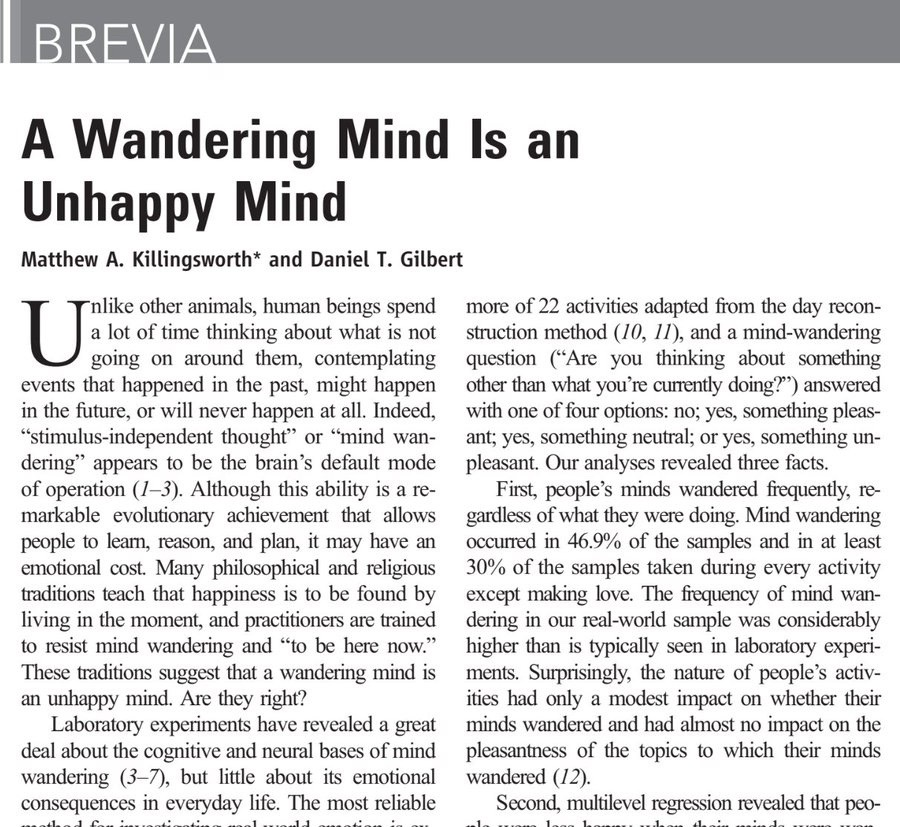
By making current events a required part of education, we are essentially mandating that children consume mental Coca-Cola, and then we wonder why they seem anxious and pessimistic about the future and why the actual educational outcomes achieved in our schools are declining.
The increasing ideological slant to schools is also one reasons parents in record numbers are looking for alternatives (see declines in public school enrollment + growth in private school, homeschool and microschool enrollment)
Politics in Disguise
There is another problem with current events in schools.
They are rarely taught neutrally, because they cannot be.
The people who are most passionate about teaching current events often have strong opinions about those events.
This is not surprising or necessarily blameworthy. It is human nature to care more about teaching things you find important. But it means that current events education inevitably imports the political and moral frameworks of the teachers.
In polarized times, this becomes especially problematic.
Worse, students are being drafted into political wars not of their own making.
Classroom “current events” discussions often become proxies for adult conflicts, with children pressured to signal loyalty to one side or another or fear reprisals if they don’t agree with their teacher’s views.
This does not build civic capacity or engagement.
And this focus on current events does more than shape students. It shapes schools and the teachers they attract.
When classrooms are turned into stages for political expression, they attract educators who are motivated by activism. Over time, this creates a vicious negative feedback loop: ideological content pulls in ideological teachers, which deepens the politicization of the school itself.
Don’t believe me?
Read through the National Education Association 2025 Handbook below. It’s long so if inclined, just Ctrl F for mentions of “mathematics” vs a term like “climate change” as just 1 example. For context, the NEA is the largest teachers union in the USA charged with educating our young people.
Worse, students are being drafted into political wars not of their own making.
Classroom “current events” discussions often become proxies for adult conflicts, with children pressured to signal loyalty to one side or another or to not say what they actually believe if it doesn’t align with their teacher’s beliefs.
This does not build civic engagement or reinforce our democracy as the National Education Association highlights as one of its core values.
It builds mimicry “at best” and increased polarization at worst.
I have watched school boards and communities fracture over these differences.
The debates become toxic precisely because they are not about uncontroversial subjects like algebra or grammar, topics where there is broad agreement on what should be taught.
Instead, they are about whose interpretation of current events should be presented to children as authoritative.
The common response is “we should just teach media literacy.”
But in practice, media literacy often devolves into judgments about which news sources are “trustworthy,” usually aligning with the teacher’s own views. What begins as “critical analysis of sources” ends with students learning that Fox News is propaganda while MSNBC is reliable journalism (or the opposite), depending on who is teaching and where.
The consequences are already visible.
Pew Research shows trust in public schools has plummeted from 58% in the 1970s to just 29% in 2023.
When schools are perceived as battlegrounds for cultural and political disagreements, a few things happen:
- families exit
- academic performance suffers
- polarization increases, i.e. red schools and blue schools

The Historical Pattern Recognition Alternative
If we want students to understand the world, history offers a far better tool than news.
History does not repeat, but as Mark Twain noted, it often rhymes. The patterns in human affairs recur in ways that make historical knowledge vastly more useful than knowledge of current events.
Consider how pattern recognition from history creates lasting insight:
- A student who understands the causes of the Great Depression or Dot Com bust will recognize financial bubbles in any era.
- One who has studied propaganda in authoritarian regimes will spot manipulation techniques across the political spectrum.
- Someone who knows how technological revolutions transformed societies will better navigate our own technological transitions.
- A student who understands the true root causes of historical conflicts will see beyond the superficial justifications given for modern wars.
These skills are permanent intellectual assets that compound over time.
News consumption, by contrast, is a tax on your attention. Yesterday’s headlines are worthless almost immediately as today’s crisis takes precedence. News consumes significant mental bandwidth and leaves your mind as quickly as it arrived, replaced by outrage at the next.
News is fleeting.
History is sticky.
Once you learn how propaganda or bubbles or institutional breakdowns work, you carry those lessons as tools for life. News is slippery. Yesterday’s story
Studying historical patterns also creates immunity to simplistic narratives. History is messy. It resists easy heroes and villains. It teaches that unintended consequences often overwhelm intentions. These are precisely the nuances that disappear in most current events coverage especially when tensions are high.
A Better Approach: What We’re Doing
At the School of Entrepreneuring we are replacing current events with challenges that build lasting intellectual tools & capabilities.
One example is the “Information Archaeology” challenge, where students trace the origins of widely-believed “facts” to determine their validity. They investigate claims such as:
- “We only use 10% of our brains”
- “You need to drink eight glasses of water daily”
- “The Great Wall of China is visible from space”
- “Sugar causes hyperactivity in children”
- “Goldfish have a 3 second memory”
Through this process, they learn to follow information trails, distinguish between research and interpretation, recognize how incentives shape information, and present nuanced findings.
This builds transferable skills, avoids importing political viewpoints, promotes genuine critical thinking, and remains relevant regardless of the day’s headlines.
The world does not need more news consumers who get lost in and all too often angry about the noise of daily events.
It needs independent thinkers who know how to be valuable in their families and communities.
Schools that move beyond current events & politics do more than help students, they also change who chooses to teach there.
A school that prizes enduring skills and independent thought will draw educators and talent committed to education itself, not ideology. That is the kind of school we increasingly need.
If you’ve read this far and found yourself agreeing, we’re building a national network of Schools of Entrepreneuring.
I also write a newsletter Unf^cking Education where I dig into how we can fix our nation-building infrastructure (aka education).
Leave a Reply