It’s perhaps weird to say a book about sports and data changed my life.
It’s even stranger when that book is about baseball — a sport I have near zero interest in watching but which I admire deeply for its relentless desire and ability to use data and technology to innovate and look for an edge.
Btw, the book I’m referencing above is Moneyball (published in 2003).
It highlighted how Billy Beane and the Oakland A’s used data analytics in player evaluation & selection.
It wasn’t a baseball story as much as a story of the nerds winning.
As a nerd my whole life, those types of stories resonate 🙂
It was a story of migrating away from a reliance on abstract, artisanal and imprecise measures of “innate” talent embedded in traditional scouting to a more scientific, data-driven, and technologically advanced approach.
It was a story of facts over feelings.
For CB Insights, the company I founded, it actually formed the basis of our early customer pitch, i.e. “We’re Moneyball for private markets”.
It also informed the product we built, i.e. the algorithms that scored many things including:
- management team quality
- the health of an industry
- the momentum of a company
Our goal, like that in Moneyball, was on identification and selection. For us, that was for companies.
Moneyball’s focus was on the identification and selection of undervalued players.
In finance terms, Moneyball was identifying talent arbitrage, i.e. the delta between perceived value of a player and actual value.
From player identification to player development
Player development (PD) is a cousin of Moneyball that emerged on the scene later.
While Moneyball is about teams finding pre-existing talent, player development is about teams competing to improve and create talent.
Interest and efforts around player development have accelerated as data and technology have become available. The introduction of high-speed cameras, wearable technology, and advanced software in the early 2010s caused an explosion in PD. (Note: AI is about to usher in a whole new wave of innovation)
By the mid-2010s, the integration of data and technology in PD had become the norm across Major League Baseball and started influencing other sports as well.
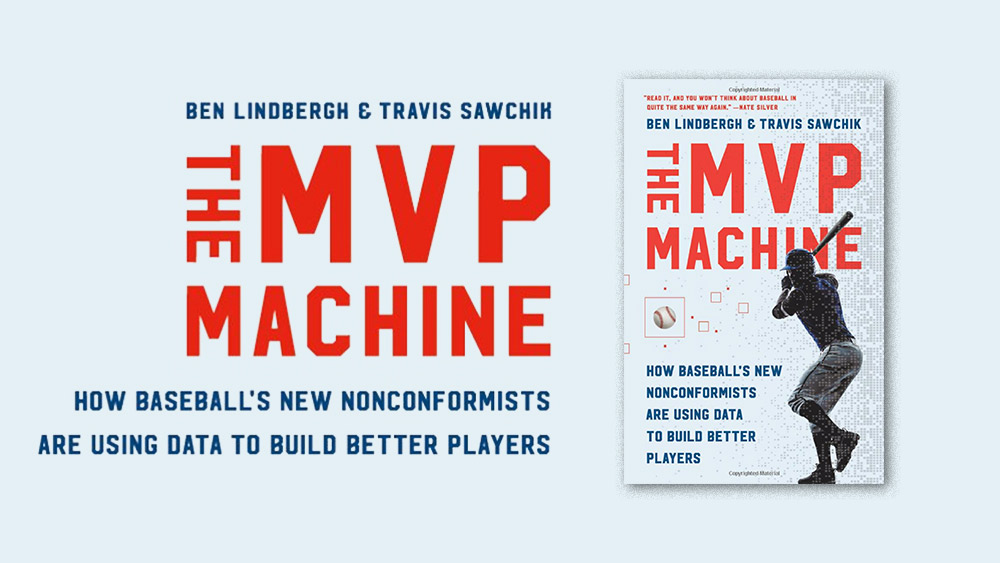
The Moneyball equivalent book for the world of player development is a book entitled “The MVP Machine” by Ben Lindbergh and Travis Sawchik.
The book is well-researched, insightful and full of stories that explore how cutting-edge data and technology is transforming the development of baseball players.
- Player development revolution: It emphasizes the shift away from traditional scouting and training methods to modern, data-driven approaches that are more precise and scientific and which can significantly improve players.
- Data & technology: And it highlights how this is done by introducing the role of advanced analytics, biomechanics, wearable technology, and high-speed cameras in player training and performance enhancement.
- Organizational Change: It discusses how forward-thinking organizations, like the Houston Astros and Los Angeles Dodgers, are at the forefront of this player development revolution and the changes this focus has brought to those orgs..
And the book details how PD has had a profound impact on traditional scouting.
The Astros, a pioneer in the player development, had 55 scouts in 2009.
By 2019, they had 20.
The migration to data and technology meant, as the authors highlighted, that any type of gut feel or subjective view was discounted.
Teams realized that the human eye could not be as perceptive as a machine that can analyze video.
Interestingly, this migration to data and technology has led to a paradox of sorts for baseball – one that probably makes it unappealing to watch as a spectator (and one I certainly feel).
The authors call this the Paradox of Progress.
The game is better, but it feels worse as a viewer. While science may win on the field to give teams a better chance at winning, the reality is that aesthetics wins hearts & minds.
The same phenomenon I’d argue is happening to basketball which has become more analytical and statistical and less aesthetic.
But I digress.
How might we bring the player development models to students in The School of Entrepreneuring?
What got me interested in the book are the broader implications on talent development in other fields and how more personalized, data-driven strategies, in particular, might be employed in education and The School of Entrepreneuring we are building.
What are the applications of the player development philosophy and discipline as articulated in The MVP Machine to an entrepreneuring education.
Could we enable a similar Student Development (SD) discipline and movement that includes:
- Data-driven development?
- Technology integration?
- Continuous improvement?
- Personalization?
- Skill development?
I’ve only started to think about this, but let me provide an example below.
For entrepreneurs, presenting is a foundational skill as they’re always persuading in some form or the other, i.e. persuading customers, potential hires or investors.
For an entrepreneur, persuasion is a foundational skill that they must develop and improve.
It is impossible, however, for coaches/teachers to work with students 1:1 prior to every important meeting they might have.
This was borne out in my conversations with teachers who revealed that they spend very little time teaching today given the many demands on their time.
So finding finding ways to make them (both students and teachers) bionic using data and technology would be powerful.
How might this look in practice?
We provide students with AI-driven communication coaches that provide real-time feedback on speaking and presentation skills. Students can use this AI-driven communicaiton coach (after it is vetted by us) and use that for regular feedback and as a way to continuously improve.
Research shows that this type of regular feedback is actually better for students than more episodic feedback which they often get.
We’d then take the feedback from these AI driven communication coaches and pass them to human coaches as a way to personalize and tailor development efforts to each student.
And this same model can be used to enhance student skills at each and every step of building a business. Imagine your own personal Aristotle who can help you with ratios and probability & statistics as you’re developing the financial model for your business?
The possibilities are endless.
There is a lot education can learn from the player development discipline being brought to many sports.
We want to create an environment where students who are eager to learn are given tools to succeed that will ultimately give them an unfair advantage.
This means that things that can’t be measured or correlated today might in the future.
And we will need to think about how to do that so we can build a systematic & efficient method to improve students.
The authors of the MVP Machine say that “Only the curious and the driven will excel in the future of enlightened athletics.”
We should expect the same of enlightened education.
Leave a Reply